
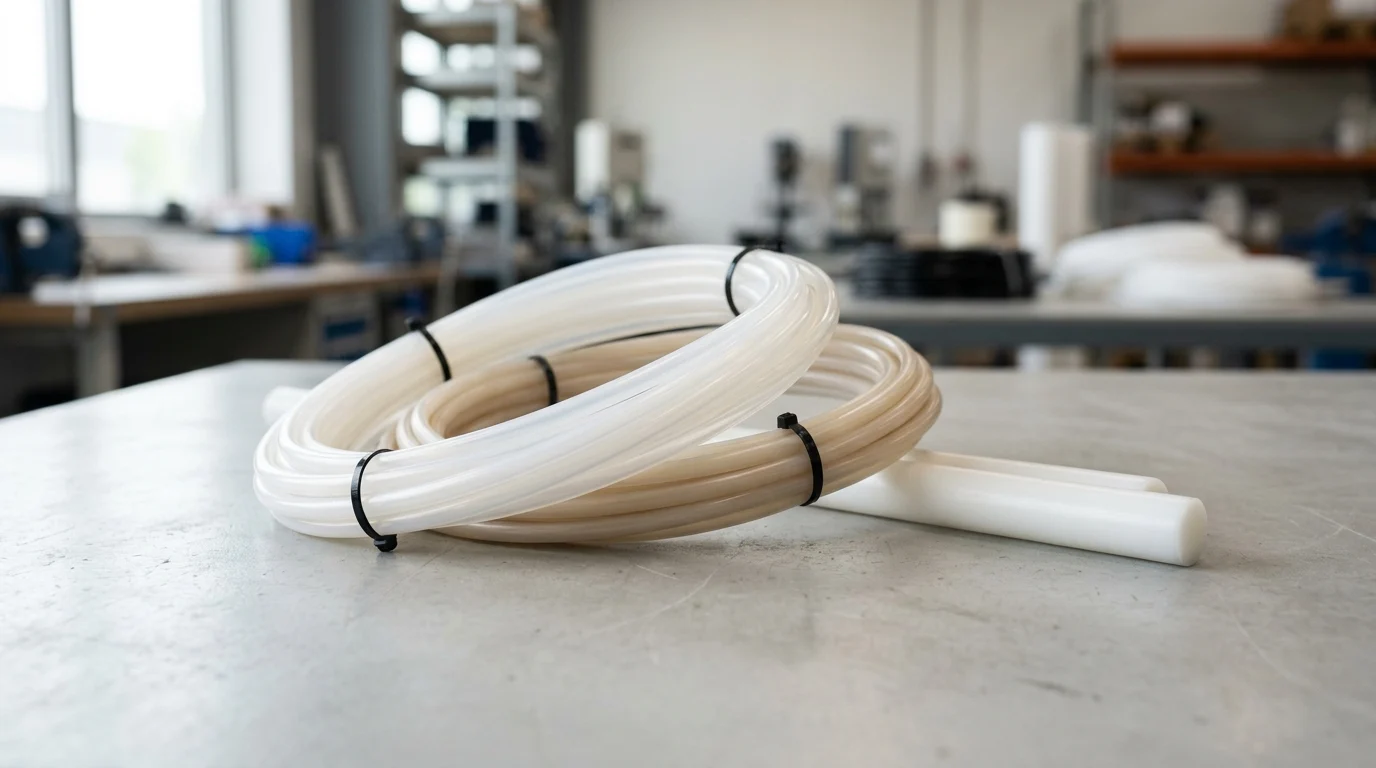
Why Extruded Nylon Rod Selection Matters
Whether designing wear pads for a heavy-duty mining conveyor or custom bushings for marine equipment, specifying extruded nylon is never just a routine box-ticking exercise. When evaluating manufacturing methods, the decision comes down to volume, tolerance, and tooling costs: machining extruded rod stock is ideal for low-to-medium volumes (typically 50 to 5,000 units), tight tolerances, and rapid turnarounds without upfront die costs, whereas custom profile extrusion or injection molding suits high-volume, near-net shapes where expensive tooling (often exceeding $5,000–$15,000) can be amortized. This guide focuses specifically on selecting and machining extruded stock for those precision or lower-volume needs. Getting this material choice wrong often results in premature component failure under load, costing both time and money.
Engineering plastics offer incredible versatility, but they demand a deep understanding of their mechanical realities before machining begins. It is critical to examine how the material is manufactured and how it reacts to its environment to ensure fabrication teams are set up for success.
Extruded Nylon vs. Cast Nylon
When comparing extruded to cast nylon, the primary difference lies in the manufacturing process and the resulting molecular weight. Extruded nylon—which commonly includes both Nylon 6/6 (PA66) and Nylon 6 (PA6)—is forced through a heated die. This process aligns the polymer chains, promoting a more crystalline structure (though final crystallinity depends heavily on thermal history) and yielding a typical dry-as-molded (DAM) tensile strength ranging from 11,000 to 12,000 psi for unfilled grades (ASTM D638) and a molecular weight typically between 20,000 and 30,000 g/mol.
Cast nylon, which is usually Nylon 6 (PA6), polymerizes directly and slowly in the mold, leading to a higher molecular weight (often 70,000 to 100,000+ g/mol). This makes cast material ideal for massive, thick-walled parts or molded near-net shape blanks because it has lower internal stress. However, for smaller diameters (usually anything under 2 inches or 50mm), machining from extruded nylon rod is generally preferred for its superior impact resistance, stiffness, and overall machinability.
Load, Wear, Moisture, and Temperature Factors
A critical caveat with nylon is its hygroscopic nature. Water acts as a plasticizer in the material; as it absorbs moisture, its impact resistance improves, but its tensile strength and stiffness drop significantly. In high-humidity environments, standard conditioned extruded stock can absorb up to 8% of its weight in moisture at saturation (which can take 24 to 48 hours fully submerged, or several months in ambient air), though this is a representative maximum that varies by specific grade and supplier.
Tight-tolerance components, such as sleeve bearings, have been known to seize completely if engineers fail to account for the resulting linear dimensional swelling, which can reach up to 2% depending on part geometry and environmental conditioning. Thermal limits and environmental exposures also require close monitoring. While short-term temperature spikes are manageable, the continuous service temperature for standard extruded Nylon 6/6 peaks around 210°F (99°C), with a Deflection Temperature Under Load (DTUL at 264 psi) typically around 160°F to 190°F (71°C to 88°C). Furthermore, heavy-duty applications must account for potential creep under sustained loads, UV degradation during prolonged outdoor exposure, and severe chemical resistance limitations when exposed to mineral acids, phenols, or strong oxidizers. If the application runs hotter, operates fully submerged, or faces harsh chemicals, engineers must request specific compatibility data from the manufacturer rather than relying on general statements to avoid field failures.
Machining, Quality, and Grade Considerations
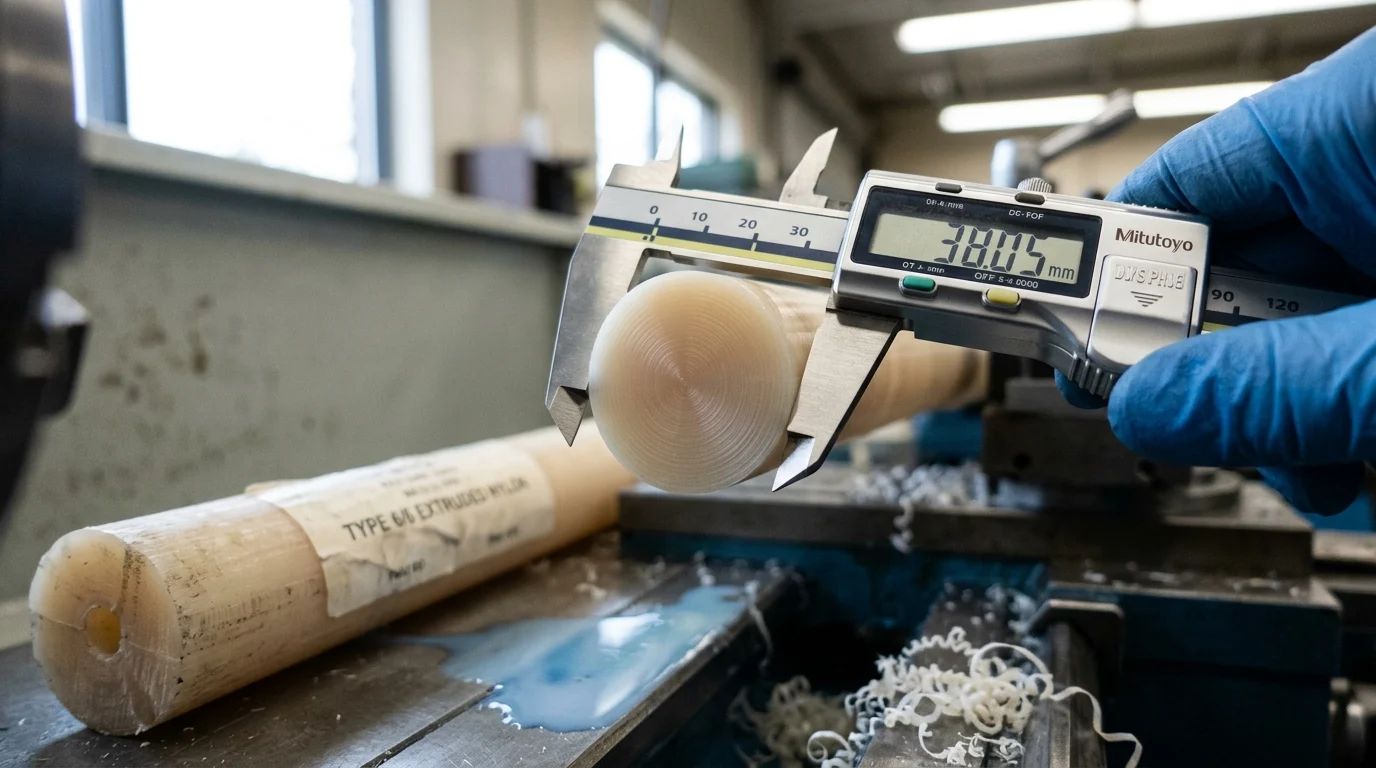
When a fresh batch of machinable stock arrives on the shop floor, the immediate concern shifts from material science to practical fabrication. Nylon is a fantastic material to turn and mill, but it demands careful attention to its thermal properties and internal mechanics.
Machining Performance and Tolerance Control
Nylon machines beautifully provided heat generation is kept to an absolute minimum. Best practices require high-speed steel (HSS) or micro-grain carbide tooling with extremely sharp, positive rakes (typically 5° to 15°) and ample clearance. Typical turning speeds range from 500 to 800 Surface Feet per Minute (SFM) with feed rates of 0.004 to 0.010 Inches Per Revolution (IPR). Note that when machining glass-filled grades, the material becomes highly abrasive, necessitating carbide or diamond-tipped cutters to prevent rapid tool wear. Nylon tends to produce long, stringy chips that can easily wrap around tooling or the chuck, marring the surface finish. To prevent this, operators should program a slight pause or use peck drilling cycles to break those chips early.
Because nylon has a relatively high thermal expansion coefficient—roughly 5.5 x 10^-5 in/in/°F (as measured per ASTM D696)—generating excessive friction means the target dimension might be hit on the machine, only for the part to shrink out of spec once it cools down. Holding tolerances of ±0.002 to ±0.005 inches on diameters under one inch is achievable, but requires aggressive coolant use and taking very light finishing passes.
Diameter Stability and Material Consistency
Fabricators must also be acutely aware of the internal stresses locked inside extruded Nylon 6/6. The extrusion process naturally leaves residual stress in the material as it cools rapidly upon exiting the die. If the center of a solid rod is aggressively bored out, the outer diameter will often warp or bell-mouth as those stresses are released.
To combat this dimensional instability, industry best practice recommends rough machining the part, then annealing it before performing the final finishing cuts. However, annealing must be approached cautiously: operators should strictly follow the manufacturer’s datasheet for the specific grade’s recommended temperature (often 300°F to 320°F for PA66) and duration (typically 1 hour per inch of cross-section), as uncontrolled annealing can severely degrade the polymer’s mechanical properties. Additionally, keep in mind that commercial rods are intentionally supplied oversized—usually by +0.010 inches to +0.030 inches on the diameter for rods under 2 inches, and up to +0.125 inches for larger stock—to ensure the outer surface can be cleaned up completely for a perfect finish.
How to Specify, Source, and Approve Extruded Nylon Rod
Sourcing the right material means looking well beyond the base polymer and
Key Takeaways
- Choose machined extruded nylon rod for precision parts, fast turnaround, and low-to-medium production runs of roughly 50 to 5,000 units.
- Consider custom extrusion or injection molding only when high production volume can justify tooling costs that may exceed $5,000 to $15,000.
- Use extruded nylon rod for smaller diameters, especially under about 2 inches or 50 mm, where machinability, stiffness, and impact resistance are often advantageous.
- Account for nylon’s moisture absorption because saturation can reach about 8% by weight and linear swelling can approach 2% in demanding environments.
- Check temperature exposure carefully, since standard extruded Nylon 6/6 typically has a continuous service limit near 210°F (99°C).
Frequently Asked Questions
When should I machine extruded nylon rod instead of using custom extrusion?
Machining extruded nylon rod is usually best for low-to-medium volumes, tight tolerances, and fast turnaround, especially around 50 to 5,000 parts. Custom extrusion or molding makes more sense when high volumes can justify tooling costs.
What is the main difference between extruded nylon and cast nylon?
Extruded nylon is forced through a heated die and is commonly used for smaller rods and precision machined parts. Cast nylon polymerizes in a mold, has higher molecular weight, and is often better for large, thick-walled or near-net-shape components.
Is extruded nylon rod suitable for heavy-duty bushings and wear pads?
Yes, extruded nylon rod can work well for bushings, rollers, wear pads, and similar heavy-duty parts when load, moisture, temperature, and dimensional tolerance are properly considered before machining.
How does moisture affect extruded nylon components?
Nylon absorbs moisture, which can improve impact resistance but reduce stiffness and tensile strength. Dimensional swelling can be significant, so tight-clearance parts such as sleeve bearings must be designed with moisture exposure in mind.
What temperatures can standard extruded Nylon 6/6 handle?
Standard extruded Nylon 6/6 typically has a continuous service limit around 210°F (99°C). Its deflection temperature under load is commonly around 160°F to 190°F, depending on grade and test conditions.
Post time: Jul-13-2026