
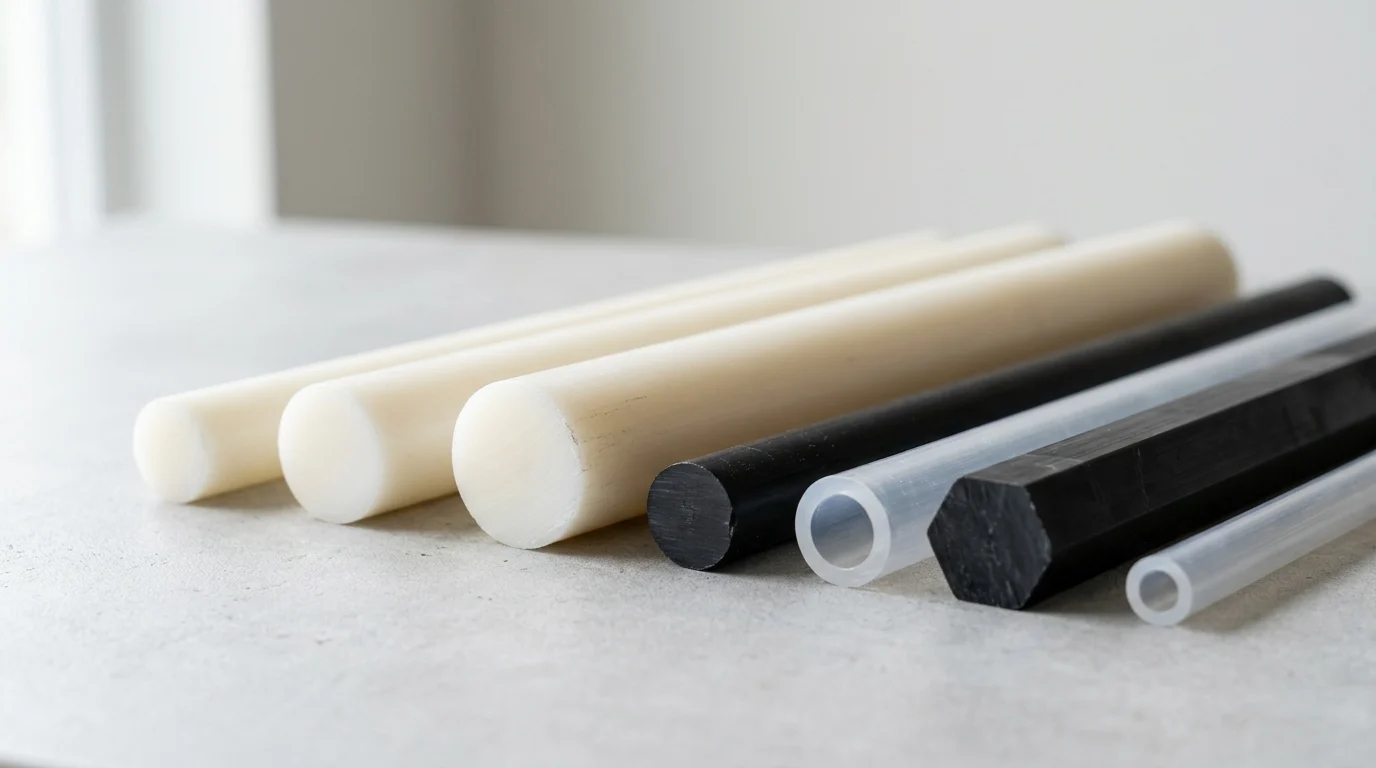
Why Use Extruded Nylon Wear Strips
In busy manufacturing environments, the screech of metal-on-metal contact often indicates an impending maintenance failure. For years, engineers defaulted to brass or bronze wear pads, accepting constant lubrication and frequent replacements as standard operating conditions.
Pivoting to extruded polymers provides a reliable alternative. Replacing traditional metal guides with a well-designed extruded nylon wear strip not only quiets the operation but can drastically extend the lifecycle of the chains, belts, and moving components that ride along them.
How They Reduce Friction and Wear
The effectiveness of extruded nylon lies in its inherent self-lubricating properties and structural integrity. Extruded Nylon 6/6 typically boasts a tensile strength of up to 12,000 psi under optimal conditions, according to standard manufacturer datasheets. This allows the material to withstand significant impact without deforming under the weight of heavy industrial components.
When steel chains run over a nylon bed, the dynamic coefficient of friction drops significantly—often landing between 0.15 and 0.25 in dry conditions, depending on load, speed, and surface finish. This lower friction helps prevent parts from binding and galling, provided the application stays within the material’s pressure-velocity (PV) limits. The PV limit is calculated by multiplying the pressure (P in psi) by the sliding velocity (V in feet per minute). For unlubricated Extruded Nylon 6/6, the maximum continuous PV limit is generally around 3,000 to 4,000. Staying below this threshold prevents excessive heat buildup. Additionally, because nylon naturally absorbs shock, it reduces system vibration, which protects motor bearings and gearboxes from premature fatigue.
Best Applications for Extruded Nylon Wear Strips
These strips excel in high-load material handling environments, such as bottling lines, heavy packaging conveyors, and timber processing plants where abrasive debris and heavy weights are common. When specifying materials for food processing or bottling applications, it is critical to verify that the selected grade is FDA-compliant for direct food contact.
In high-throughput system designs, utilizing a nylon guide rail beneath a conveyor chain provides a sacrificial wear surface that is cost-effective to replace and exceptionally durable. They are also well-suited for telescoping boom guides and elevator slide pads requiring a material that resists crushing under high compressive loads.
How Do Nylon Wear Strips Compare with Other Plastics
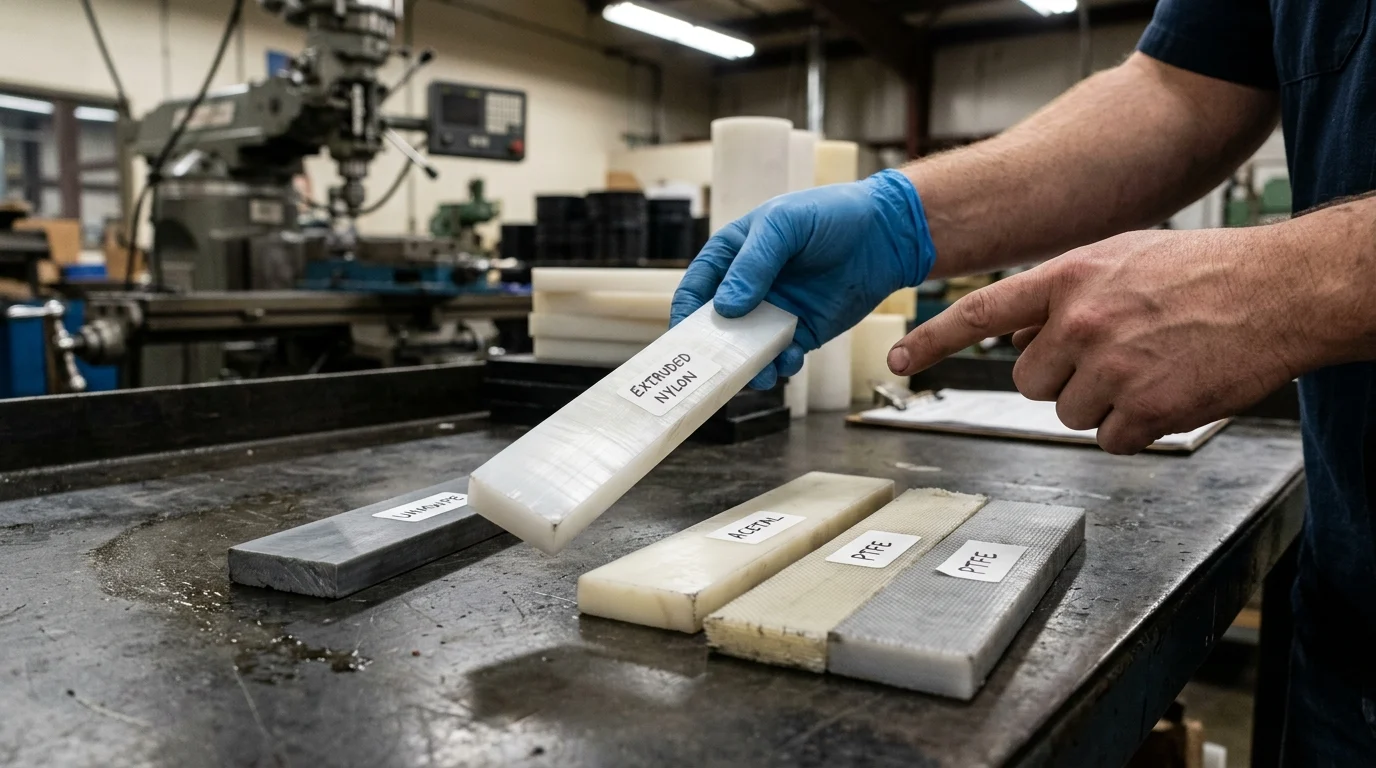
Engineers frequently consider defaulting to UHMW polyethylene for every sliding surface. While UHMW is an exceptionally low-friction material, it is not universally applicable.
It is critical to evaluate the specific operating environment—especially regarding weight limits, temperature, chemical exposure, and UV degradation—before committing to a specific engineering polymer. Incorrect material selection can lead to premature failure and jammed machinery.
Key Factors: Load, Wear, Moisture, and Cost
When evaluating engineering plastics for a mechanical design, three primary options stand out. Nylon carries heavy loads effectively but absorbs moisture. Acetal (POM) is dimensionally stable in wet conditions, and UHMW offers extremely low friction but is much softer.
The table below outlines general specifications. Keep in mind that 24-hour moisture absorption does not represent full saturation, and dynamic friction varies based on load, speed, and mating surface finish.
| Material | Max Operating Temp (Continuous) | Moisture Absorption (24h)* | Dynamic Friction vs Steel** | Relative Cost |
|---|---|---|---|---|
| Extruded Nylon 6/6 | 180°F – 210°F | 1.2% – 1.5% | 0.15 – 0.25 | Medium |
| UHMW-PE | 180°F | <0.01% | 0.10 – 0.15 | Low |
| Acetal (POM) | 180°F | 0.20% | 0.20 – 0.25 | Medium-High |
*Note: 24-hour moisture absorption values specifically for Extruded Nylon 6/6 do not represent full saturation. Nylon 6/6 can absorb up to 7% moisture by weight over time, significantly impacting dimensional stability. Max temperatures listed are for continuous service; short-term spikes may tolerate higher heat.
**Note: Dynamic friction values are not absolute; they depend heavily on the specific polymer grade, added fillers (like MoS2 or oil), load, speed, and the mating surface’s finish.
When to Choose Nylon Over UHMW or Acetal
Nylon is generally preferred over UHMW when raw compressive strength is required. If a conveyor carries heavy cast-iron engine blocks or dense pallets, UHMW is susceptible to cold-flow, meaning it deforms permanently under continuous pressure.
In heavy-duty applications, a robust heavy-duty nylon component handles higher PSI demands without losing its profile shape. However, nylon has notable caveats and limitations that must be engineered around. Chief among these is moisture conditioning: in highly humid environments, nylon absorbs water, leading to dimensional swelling and a reduction in mechanical properties like tensile strength and stiffness. Furthermore, while nylon resists immediate deformation, it is still subject to long-term creep under sustained heavy loads.
If the machinery operates in a washdown environment, is exposed to harsh chemicals—specifically, nylon has poor resistance to strong acids and oxidizing agents—or is constantly submerged, acetal is a safer choice due to its dimensional stability. Standard nylon also degrades under prolonged sunlight exposure, requiring specifically formulated UV-stabilized grades for outdoor applications. Finally, while nylon can handle intermittent high-temperature spikes, its continuous operating limit generally caps at 210°F.
How to Specify, Source, and Install Nylon Wear Strips
Once nylon is selected for an application, the next critical steps involve determining the correct specifications and executing proper installation.
Many sound mechanical designs fail in the field due to poor sourcing choices and improper installation practices.
Key Takeaways
- Use extruded Nylon 6/6 wear strips to reduce metal-on-metal contact, galling, lubrication demand, and unplanned maintenance in conveyor and guide systems.
- Check the application’s pressure-velocity value and keep unlubricated extruded Nylon 6/6 below the typical continuous PV range of 3,000 to 4,000.
- Specify extruded nylon when long, continuous, thinner profiles with a smooth die-finished surface are more important than very large cast dimensions.
- Design nylon wear strips as sacrificial, replaceable surfaces beneath chains, belts, slide pads, and guide rails to protect more expensive equipment components.
- Verify FDA-compliant nylon grades before using wear strips in direct-contact food, beverage, bottling, or packaging applications.
Frequently Asked Questions
What is an extruded nylon wear strip?
An extruded nylon wear strip is a long, dense polymer profile—often made from Nylon 6/6—used as a low-friction contact surface between moving industrial components such as chains, belts, guides, and slides.
How does extruded nylon reduce equipment wear?
Extruded nylon lowers friction, absorbs shock, and helps prevent metal-on-metal galling. This reduces heat, vibration, and component fatigue, helping chains, bearings, gearboxes, and guide systems last longer.
What is the typical coefficient of friction for extruded Nylon 6/6?
In dry conditions, extruded Nylon 6/6 often has a dynamic coefficient of friction around 0.15 to 0.25, depending on load, speed, surface finish, and operating conditions.
What does PV limit mean for nylon wear strips?
PV limit combines pressure and sliding velocity to estimate heat buildup risk. For unlubricated extruded Nylon 6/6, continuous PV limits are generally around 3,000 to 4,000, so applications should be designed below that range.
Where are extruded nylon wear strips commonly used?
They are widely used in conveyor systems, bottling lines, packaging equipment, timber processing, telescoping boom guides, elevator slide pads, and other high-load material handling applications.
Post time: Jul-13-2026